



 Progress:

Your B2B brand rocks. Why isn’t anyone listening?

In the immortal words of the band Lit, “It’s no surprise to me, I am my own worst enemy.” Yet when it comes to B2B copy, many companies are completely surprised that their words could be one of the biggest things hindering their business’s chances of greater success.
As a B2B copywriter, I keep my ears (and eyes) open for B2B marketing in the wild. And oftentimes, I’m taken aback by what I come across. Ads that read like liner notes for ERP software. Brochures that are wall-to-wall specs. Social posts that are more like echo chambers. These kinds of approaches can miss the beat and cause audiences to disconnect from your brand. So, let’s take a spin through some common B2B copy missteps and how you can finely tune your B2B copy.
Why your messaging might be skipping a beat
You’ve invested in brand strategy. You’ve workshopped your mission. Your vision. Your value prop. You’ve got positioning statements, brand pillars and RTBs galore. You’ve paid your dues. So, what gives?
Well, maybe you’re bringing things into the limelight that should be kept backstage. A brand strategy isn’t a go-to-market message. It’s the inspiration behind your new smash-hit campaign.
Let’s look at Apple. I mean, with a name that was semi-influenced by the Beatles’ Apple Corp, we have a musical tie-in here. As we all probably know, Apple is about challenging the status quo, empowering creative thinking and creating user-friendly designs. To embody this, Apple didn’t talk about processing speeds, memory sizes or other tech specs. Instead, what did they tell us? To “Think Different.” And that resonated with punks, pop artists and people everywhere.
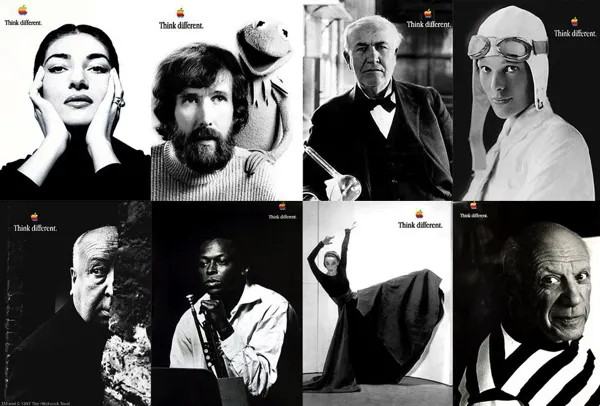
Branding work is critical to defining who you are. It’s a necessary step to finding your rhythm. But it’s not what’s going to sell out shows. That’s what connecting with your audience does. So when the curtain rises, it’s time to show your audience it’s all about them.
While all this is necessary to set the scene, there’s one thing your audience doesn’t resonate with: you, talking to yourself.
Think about the last time you got a song stuck in your head. There’s a good chance that it did because you felt a connection to the lyrics. The story. Recovering from a breakup, taking a killer road trip or just that unexplainable feeling that’s more than a feeling.
At this point, that song is probably in your head again. Now, compare it to your company’s website copy. Are you connecting in the same way? You might be if you helped create it. But for your audience, maybe not so much.
You’re so vain, you probably think this copy’s about you
Why? Well, take a look at the copy. Did you write it for yourself or for your fans? Making your copy personal is a good thing. It can humanize your business, form relationships with clients and help set you apart from your competitors — all of which sounds great!
But none of that will happen if you’ve unconsciously been playing to an audience of one this whole time: yourself. Remember, even though it’s your business, it really isn’t about you. It’s all about your clients. And when they hear that, you’re on the right track.
However, everyone needs to start crafting their story somewhere. Do the groundwork. Carve out your angle. Iron out the details. All that’s great while you’re still figuring things out in your garage. Not so great when you need to take the stage. You need to have verses (body copy), chorus (headline) and bridge (connecting with your offering to your audience’s need) all polished up so it gets stuck in your client’s head.
So how do you figure this out? Test your material. Maybe you share early versions of your messaging with trusted clients to see how they react. You could spend some time hanging out where your audience does. See what they see. Hear what they hear. Getting out of your “studio” can go a long way toward finding your inspiration. Or you could simply A/B test some of your materials to see which side your audience favors.
Increase the BPM at your DAW and feed it into my IEM
Yeah, not really sure what that means either.
But I do know that it relates to something I often see with B2B copywriting: Leaning too much into “insider speak.” Specs. Corporate jargon. Acronyms, acronyms, acronyms. Just because your audience is a business doesn’t mean they want to talk shop all the time. The people making the decisions for their business are, well… people. People who also see lots of B2C copy. So, your B2B copy needs to be on par. This isn’t Severance. Home life and work life aren’t independent of each other. OK, that wasn’t a music reference, but I think it makes the point. Business is personal a lot of the time to a lot of people.
Avoid acronyms, internal speak and marketing jargon. It’s cool to talk like that among yourselves, but no one outside your office is going to sing along to, “We will, we will give you consistent liquidity from our Commercial Lending Division.” Not a crowd favorite.
And speaking of liquidity… when you need to rehydrate, which of these lines will get you grabbing a particular brand of water:
- Reverse-osmosis from a spring-fed stream
- Sourced from groundwater containing at least 250ppm of TDS
- Murder your thirst
Me? “Murder your thirst” all the way. In a non-violent way of course. Liquid Death’s take on the health and wellness play of many bottled water brands has set it apart and solidified the brand’s presence as the anti-bottled-water water. In their own words, “For centuries, all the funniest and coolest marketing and branding was only done for unhealthy products like beer, fast food, candy, and junk food. But those days are over. Soon, Liquid Death will use health and humor to conquer the world and make all beverages Liquid Death for eternity.” Still health-focused. Just hitting on a different tone.
Finding your rhythm
Now, you might be saying, “Hey, Liquid Death is B2C.” True, but what’s stopping your B2B copy from doing the same? Nothing. Nothing at all. And to prove it, here’s a B2B example.
If you rewind to the early days of messaging platforms, you’re likely to come across terms such as “unified communications platform,” “enterprise collaboration” or “social business.” All of these are almost as unintelligible as the lyrics to “Louie Louie” by The Kingsmen (which actually sparked an FBI investigation of all things). Sure, it might hint at what something is. But it doesn’t really tell me what it’ll do for me.
So, let’s take a look at one of Slack’s previous taglines, “Be less busy.” Yes! Now you’re singing my tune. It’s a great example of speaking clearly to businesses, focusing on reducing busywork to make work life simpler, more pleasant and more productive. Sounds pretty good to me.
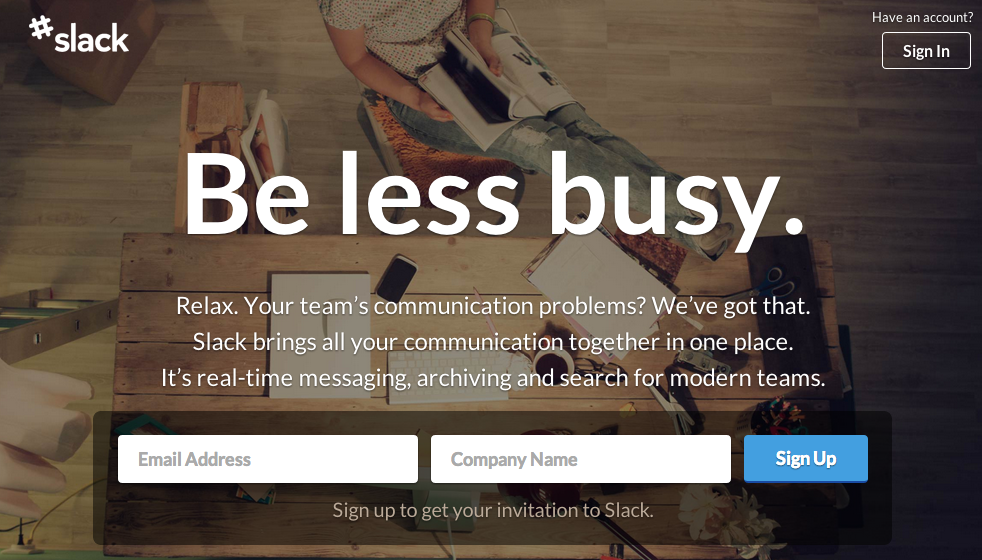
Start with sweet emotions. Nothing sappy, just something that resonates with your customers. Benefit first. Features after. A great intro hooks you for the entire song. The same goes for your headlines — and your tagline.
Write lyrics, not liner notes. If your copy sounds like it belongs in an annual report or disclaimer, it’s not right for your audience. Once you write something, read it out loud to yourself. If you stumble, so will the reader. Rewrite it. Next, read it to someone in your target demo (and who doesn’t work with you). If they’re nodding along, you’re on the right track.
The best B2B copy translates expertise into something people can instantly connect with, while showing customers how you can solve their problems. Too often, copy tries so hard to sound smart that it forgets to sound human.
– Chris McGuire, Director, Client Growth & Engagement, McGuffin Creative Group
Time for the encore
Before the curtain drops, let’s recap. All the me-focused work matters. It’s what makes you, you. It’s “your sound,” if you will. But it’s not the song that gets airplay — that’s the song that has the “lyrics” your audience can connect with. When they’re feeling what you’re laying down, everything is groovy.
Finding yourself in a rut? Unplug. Too much time spent heads down can lead to everything you write sounding the same. Collaborate with colleagues, change the scenery, see a show. A break in your routine can lead to the breakthrough you’re looking for.
So next time you write B2B copy, don’t ask, “Does this align with our core values?” Ask, “Will our customers read this and think, ‘I love these guys?’” If the answer is “Hell yeah!” then you’re ready to rock.